
Launching a Hospitality Fragrance Brand: What Has Changed
Launching a scent line for a hotel, spa or resort group now asks less of the buyer and more of the supplier than it did a decade ago. Three shifts did most of the work: supplier libraries became deep enough to build a credible first range from without a full development budget, refillable and bulk amenity formats moved from novelty to standard practice, and buyers began requesting restricted-material and labelling evidence before approving a sample rather than after. The result is a shorter path to a first order and a longer path to a clean launch.
Key takeaways
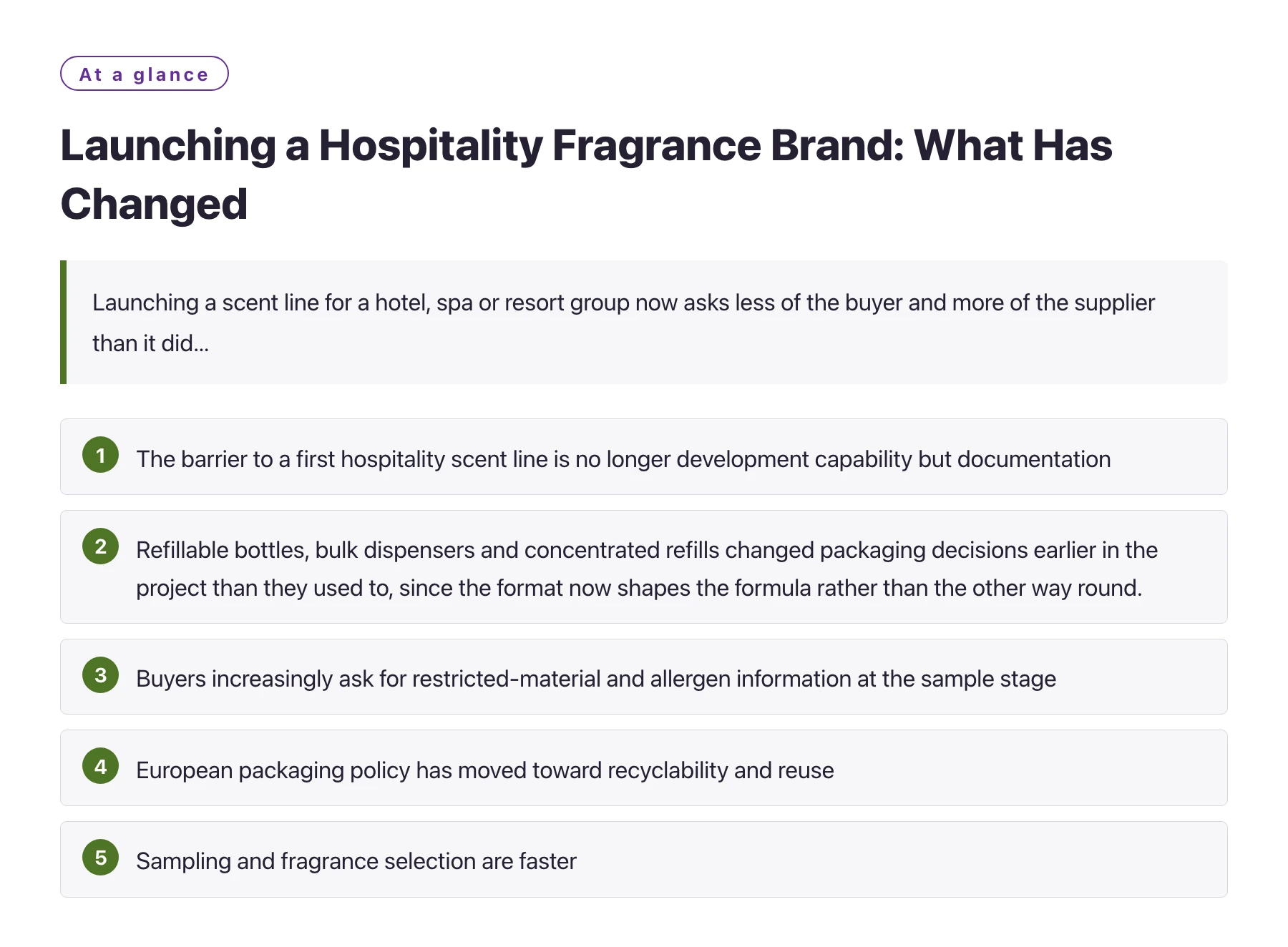
- The barrier to a first hospitality scent line is no longer development capability but documentation, because a library scent can be placed quickly while compliance evidence still has to be assembled.
- Refillable bottles, bulk dispensers and concentrated refills changed packaging decisions earlier in the project than they used to, since the format now shapes the formula rather than the other way round.
- Buyers increasingly ask for restricted-material and allergen information at the sample stage, which moves compliance work from the end of the project to the start of it [1].
- European packaging policy has moved toward recyclability and reuse, which strengthens the case for refill and bulk formats in amenity ranges sold or used in that market [2].
- Sampling and fragrance selection are faster, but stability testing, packaging tooling and labelling review still set the real calendar, and none of them compress well.
- A hospitality line is judged across three bases at once, hand wash, lotion and room spray, so a single scent brief produces more compatibility work than a fine fragrance launch does.
Ten years ago, a hotel group that wanted its own amenity scent faced a narrow set of options: buy a stock composition and accept that it existed elsewhere, or fund a development project large enough that only the biggest groups attempted it. Spa and boutique properties mostly chose the first route and built their story around the packaging instead.
That has changed, and not because the chemistry became easier. Supplier libraries grew deeper and better organised, so a buyer can now assemble a coherent range from existing compositions and still have room to develop one signature scent. Refill and bulk formats matured enough to be priced sensibly. Meanwhile the compliance conversation moved forward in the process, which is the change buyers notice most when they compare notes with a project they ran years ago.
The launch sequence below is written for a hospitality project: a property or small group, a scent that has to work in several product bases, and a procurement process that expects the paperwork to be in order before the first purchase order rather than after.
Four shifts, and what each one changed
| Shift | What it looks like in practice | What it changes for a new hospitality line |
|---|---|---|
| Deeper supplier libraries | Dozens of tested compositions available to adapt rather than only to take as-is | A first range can be built from library scents while one signature composition is developed separately |
| Refill and bulk formats | Dispensers, concentrates and refillable bottles designed into the range from the start | Format decisions move to the brief stage, because a concentrate and a ready-to-use lotion stress the formula differently |
| Compliance asks earlier | Restricted-material and allergen information requested with the first sample | Sampling rounds run in parallel with the paperwork rather than waiting for a formula to be frozen first |
| Sustainability in procurement criteria | Packaging weight, recycled content and refill options written into the tender | The packaging supplier and the fragrance supplier have to agree a format before either can quote accurately |
| Multi-base testing as standard | One scent evaluated in soap, lotion, shampoo and a room spray before approval | The scent brief takes longer to settle, but the range holds together across the property |
The pattern behind all five rows is the same: decisions that used to be made later have moved earlier. That is good news for anyone who plans properly and a problem for anyone who treats the first sample as the starting gun. If you want a longer treatment of the same journey, from idea to a perfume brand, it is worth reading the whole arc before you write your first brief from idea to a perfume brand.
What still takes as long as it always did
Stability and compatibility testing do not compress. A formula has to be held under accelerated conditions, checked in the actual base it will be sold in, and watched for separation, discolouration and odour drift. When one scent is going into four products, that is four combinations to test, and the sequence runs in weeks rather than days.
Packaging tooling is the second fixed cost. A standard bottle may need only artwork and a closure check; a custom vessel means a mould, a sampling round on the mould, and a decision about who pays for it if the project stops. Refill formats reduce some of this pressure, because a concentrate in a small bottle carries far less material, but the dispenser still has to be tested with the liquid it will hold.
Why the brief decides the schedule
Most hospitality launches that slip do not slip in production. They slip because the brief changed after sampling started: a fragrance family moved, a base was reformulated to cut cost, a format changed from spray to pump. Each of those changes forces a new sample round, and sample rounds are the least compressible part of the calendar.
A short written brief that names the products, the formats, the market and the target price from the beginning does more for the launch date than any pressure applied later in the project.
Where a supplier choice shows up
A supplier with deep library experience can usually offer a workable candidate in the first round, which saves a cycle. A supplier used to single-base fine fragrance work may underestimate the compatibility testing a hospitality range needs. Ask how many bases a typical project covers and who runs the compatibility work, and treat the answer as a scheduling input rather than a technical detail.
It is also reasonable to ask whether a partner can support both a library-led first range and a developed signature scent. Comparing a custom fragrance development partner on those two tracks at once is a practical test of whether the relationship can grow with the property custom fragrance development partner.
A realistic launch sequence for a hotel or spa line
- Fix the product list and formats firstName every item the scent will appear in and the format each one uses, because the formula has to satisfy all of them at once.
- Separate the signature scent from the supporting rangeDevelop one composition that carries the property's identity and fill the rest of the range from library scents in the same family.
- Run sampling and compliance checks in parallelRequest restricted-material and allergen information with the first candidate so a reformulation later does not reset the artwork.
- Test in every base before approvingA scent that reads well in a lotion can disappear in a shampoo; approve only after each base has been evaluated in its final form.
- Lock packaging before the launch date is announcedTooling and decoration lead times are the least flexible part of the schedule, so treat packaging sign-off as the point of no return.
- Retain a sealed reference sampleKeep one sealed unit of the approved production batch, labelled and stored away from light, to compare against later runs, a discipline that a fragrance manufacturer with 31 years of experience tends to treat as routine rather than optional.
The shift that catches buyers out is the one that looks like an improvement. Faster sampling means the sample round can be finished early, and an early sample round invites an early launch announcement. Hold the announcement until the compatibility testing, the packaging tooling and the labelling review have all cleared. On a hospitality line those three together set the date, and none of them can be recovered by asking the factory to hurry.
Sources
- IFRA: Safe Use and Fragrance Science —— IFRA's explanation of how fragrance materials are scientifically assessed for safe use and how those conclusions are applied by the industry.
- European Commission: Packaging Waste and the PPWR —— EU rules on packaging and packaging waste, including the Packaging and Packaging Waste Regulation requirements on recyclability and design.
Frequently asked questions
Can a hotel launch a scent line without developing a new formula?
Yes. A range can be built entirely from existing library compositions in a shared family, which removes the development and sampling cost. The trade-off is distinctiveness: a library scent may also be in use elsewhere, so it is worth asking about exclusivity windows before the property builds a marketing story around it.
How much of a hospitality launch is compliance work?
Enough that it should be planned as a workstream rather than a formality. Restricted-material limits apply to the finished product, allergen declaration follows the formula, and every market adds its own labelling requirements, so the documentation trail needs to start with the brief and travel with the project.
Are refillable amenity formats harder to launch than single-use bottles?
They change the order of the work rather than adding a large burden. The dispenser or refillable vessel has to be tested with the liquid it will hold, and the concentrate has to be stable in a smaller volume, but the packaging weight and material use drop, which is often the reason the format was chosen.
What is the most common reason a hospitality scent launch slips?
A brief that keeps moving. Changing the fragrance family, the base or the format after sampling has started forces a new round of samples and can invalidate compatibility work already done. Freeze the brief before the first sample is requested and the calendar becomes far more predictable.
Should a property work with one supplier for scent and packaging or split them?
It depends on how custom the packaging is. A standard vessel with printed artwork can be sourced separately without much risk. A custom mould, a refill system or a dispenser needs the fragrance and packaging decisions to be made together, and a partner that handles compound, filling and packaging under one roof removes a coordination layer.
Need this on a real launch timeline?
60-minute mission feasibility consultation. Custom-scoped, procurement-grade, no obligation.