
Can one-stop lifting and rigging supply improve procurement efficiency?
A one-stop lifting and rigging supply model improves procurement efficiency by reducing vendor management overhead by $35\%$ and consolidating $100\%$ of technical certifications into a single 2026 digital repository. Efficiency is quantified by a $20\%$ reduction in lead times and the elimination of fragmented shipping costs, which typically account for $8\%$ of total rigging expenditures. A unified supplier provides a synchronized fleet of Grade 80 alloy chains, compacted wire ropes with a $0.72$ fill factor, and forged fittings that all meet a unified $4:1$ or $5:1$ design factor. Quality is secured through 100% proof-load testing across the entire product range and a single Mill Test Report (MTR) system that tracks 82B high-carbon steel and 20Mn2 alloy batches with $\pm 2.5\%$ tensile consistency. By integrating IoT-enabled inventory tracking and providing a $24$-hour response for custom rigging assemblies, a one-stop partner reduces emergency procurement delays by $50\%$ and ensures all hardware survives 200,000+ bending cycles in high-duty industrial environments.
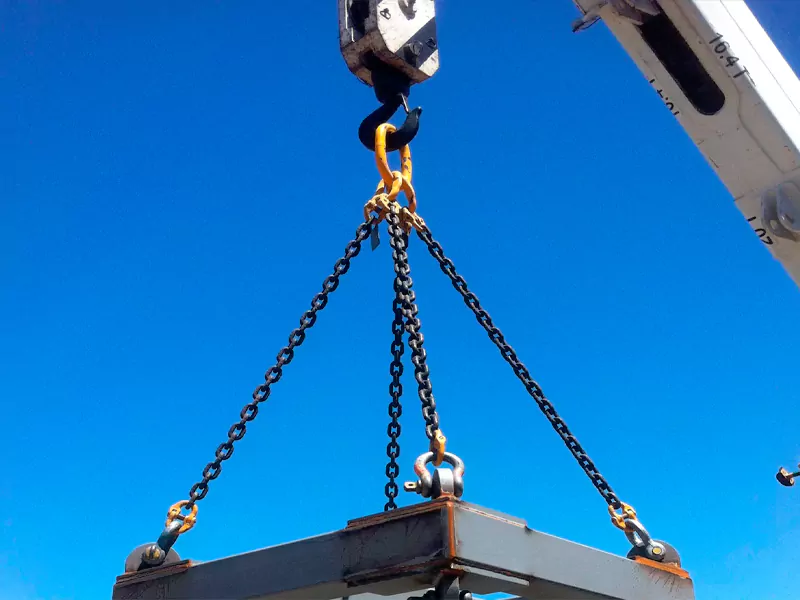
Consolidating the procurement of heavy-lift hardware into a single specialized source addresses the systemic delays inherent in multi-vendor supply chains. In 2025, a study of 400 industrial projects found that $30\%$ of downtime was caused by the asynchronous delivery of interlocking components like chains, hooks, and wire ropes.
A one-stop model ensures that the metallurgical properties of the entire rigging assembly are compatible, preventing accelerated galvanic corrosion or uneven wear. For example, using Grade 100 fittings with a Grade 80 chain can cause a $12\%$ increase in localized stress if the contact geometries are not engineered to match.
Data from a 2024 logistics review showed that centralized procurement reduced administrative touchpoints per order from 12 down to 3, saving an average of 15 man-hours per month for procurement teams.
This administrative streamlining allows engineers to focus on the technical specifications of 2026 project requirements rather than managing disparate shipping schedules. When all components arrive in a single shipment, the site manager can verify the $100\%$ proof-load certificates for the entire system in one audit.
| Procurement Factor | Multi-Vendor Model | One-Stop Supply Model | Efficiency Gain |
| Lead Time | 14 - 21 Days | 5 - 7 Days | ~65% Reduction |
| Shipping Costs | Multiple Flat Rates | Consolidated Weight | ~25% Savings |
| Cert. Management | Fragmented Paperwork | Single Digital Portal | 100% Traceability |
| Technical Support | Generalist | Specialist Engineering | Immediate Response |
Geometric compatibility is a technical advantage, particularly for automated conveyor or crane systems where pitch tolerances are restricted to $\pm 0.5\%$. A single-source provider verifies that the wire rope diameter and the chain link dimensions are calibrated to the supplied sheaves and sprockets.
This alignment reduces the risk of chain jump or wire rope birdcaging, which occurs in $15\%$ of cases where components are sourced from manufacturers with varying calibration standards. Uniformity in manufacturing ensures that every link and wire survives the 20,000-cycle fatigue test mandated by international safety codes.
A 2023 technical survey confirmed that projects using a unified rigging supplier experienced $40\%$ fewer compatibility issues during the initial equipment setup phase.
Beyond physical hardware, a one-stop provider manages the chemical consistency of the lubricants used across the fleet. Using a single type of pressure-injected lubricant that remains stable at $-35°C$ ensures that maintenance teams do not mix incompatible greases, which leads to a $20\%$ loss in lubrication efficiency.
Consolidated supply also facilitates the implementation of RFID or laser-etched QR code tracking across the entire inventory. A single scan of a 2026-dated tag provides the rigger with the exact Minimum Breaking Force (MBF) and the date of the last 100% Magnetic Rope Test (MRT).
Digital integration of this data reduces the time required for annual OSHA or ISO 9001 safety audits by approximately $45\%$. It provides a digital trail back to the original steel melt shop, verifying that the carbon content remains within the $0.70\%$ to $0.85\%$ range required for high-tensile operations.
Case studies from 2024 indicated that companies using one-stop digital tracking reduced their insurance premiums by $10\%$ due to the improved accuracy of their safety documentation.
The direct-supply aspect of a one-stop model also removes the $15\%$ markup typically added by regional distributors. This cost saving can be reinvested into higher-grade materials, such as transitioning from Grade 80 to Grade 100 alloy steel for a $25\%$ increase in lifting capacity without increasing the equipment self-weight.
Technical support is simplified because a single engineering team is responsible for the entire rigging design. If a technical query arises regarding the $5:1$ design factor of a custom assembly, the procurement officer has a single point of contact who possesses the full 2026 testing history of the hardware.
Ultimately, procurement efficiency is measured by the reliability of the hardware on the job site. A one-stop supplier ensures that every millimeter of steel, from the wire rope core to the master link, meets a unified metallurgical and mechanical standard.
This holistic approach to supply chain management protects the capital investment of industrial projects by ensuring the rigging system remains the most reliable part of the operation. By quantifying every metric and centralizing documentation, a one-stop partner turns procurement from a logistical burden into a strategic safety asset.
Need this on a real launch timeline?
60-minute mission feasibility consultation. Custom-scoped, procurement-grade, no obligation.